Adolph Gettler
Casino RoyaleAdolph Gettler is a SMERSH operative whose carefully ordinary appearance conceals a lethal role in the last phase of James Bond’s story. First encountered by Bond after Bond has been captured, Gettler leaves him alive by mistake and marks him as a spy; later, under the cover of a Swiss watch traveller, he appears at the inn where Bond and Vesper are staying. Vesper recognizes the danger immediately, while Bond initially mistakes the man for an inconspicuous passer-by.
Identity and Cover
At the inn, Gettler presents himself as an unremarkable middle-aged customer, dressed soberly and carrying a briefcase. Bond first reads him as a businessman who has simply chosen the restaurant, and sees him discussing the menu with the proprietor before taking out a newspaper. The detail that changes Bond’s assessment is a black patch fitted over one eye like a monocle rather than secured by a band. Gettler’s dark hair, brushed straight back, and conspicuously large white teeth give Bond more specific features to remember, but nothing in his manner openly announces his purpose.
The proprietor supplies a plausible cover story after Gettler has left. The stranger had enjoyed his meal, said he might return in a day or two, and claimed to be Swiss and involved in the watch trade. His accent seemed consistent with that account. This ordinary exchange—meal, travel, business, and a promised return—places Gettler in the inn’s everyday social world and gives him a reason to be passing along the coast without inviting immediate suspicion.
Bond checks the details rather than relying on the story. The Peugeot Gettler uses was hired from a reputable firm two weeks earlier; its hirer had a Swiss triptyque and gave the name Adolph Gettler, with a Zurich bank as his address. Mathis confirms through the Swiss police that an account exists in that name, though it is little used, and that Gettler is understood to have a connection with the watch industry. The inquiries establish that the identity has official traces, but they do not establish a charge against him: the Swiss police say further investigation would require one. The cover is therefore supported by particulars without being exposed by them.
Earlier Encounter with Bond
Gettler’s earlier appearance comes after Bond has been seized and held. Bond catches only a brief glimpse of glittering eyes behind a narrow black mask, along with the outline of a crag-like face beneath a hat brim and a fawn-coloured raincoat collar. Gettler tells him that he has no orders to kill him and that his survival is the second time in one day that he has been saved—first by chance, and now by mistake. He explains that, had the orders been different, he would have killed the foreign spies gathered around the man SMERSH regarded as a traitor.
The reprieve is not forgiveness. Gettler says he will leave Bond a calling card and warns that Bond, as a gambler, may one day play against one of his people; it would be better for him to be known as a spy. He then uses Bond’s restrained hand to cut a mark into it. Bond later identifies the shape as the Russian letter for SH, connecting it with SHPION, the word for spy, and with SMERSH’s name, expanded as SMYERT SHPIONAM, or Death to Spies. The mark turns Bond’s identity into a message: Gettler does not simply threaten him but labels him for recognition by the enemy.
Bond understands that the mark may have a practical cost as well as symbolic force. He expects M may insist on a return to hospital in London and further skin grafting over the back of his hand. Yet he says the injury matters little beside his decision to resign. That reaction underlines the scale of the ordeal and the lasting professional and personal consequences of Bond’s capture, even as the narrative makes Gettler’s intervention a direct warning about SMERSH’s reach.
Return to the Inn
On Saturday, Vesper reacts to the stranger before Bond understands why. Her fork falls, and she turns pale, staring over Bond’s shoulder at the man seated across the terrace. Bond sees no obvious threat: the customer appears ordinary, confers amiably with the proprietor, and reads a newspaper after noticing that he is being watched. Bond tries to reassure Vesper that the man looks innocent and asks whether she is certain he is the same person. Her physical alarm persists; she grips the table, drinks unsteadily, and then makes Bond stop himself from coming around to her.
After Gettler leaves in the Peugeot, Bond tactfully tells the proprietor that Vesper has a slight touch of sunstroke and asks about the customer. He mentions a friend who also lost an eye as a way of prompting description. The answer confirms the Swiss story but does not explain Vesper’s fear. Bond also speaks with the proprietor about the war and gestures to the man’s empty sleeve, comparing their respective misfortunes; the conversation makes the innkeeper’s own injury part of the scene’s contrast with Gettler’s conspicuously managed disguise.
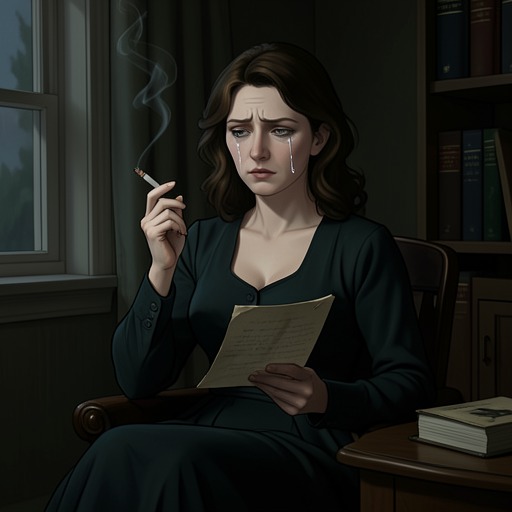
The next day, Gettler returns. Bond has already telephoned Mathis in Paris and checked the car and Swiss identity, but the information has not resolved the threat. Vesper leaves her lunch and goes directly to her room when she sees the one-eyed man again. Bond had told her what the proprietor said but withheld the prediction that the stranger might return, hoping not to worry her. Her response makes clear that official-looking credentials and a harmless public manner cannot neutralize what she recognizes. Bond follows her and finds the doors locked; when she lets him in, she is sitting in the shadows by the window, apparently watching.
Significance in the Ending
Gettler’s narrative function depends on the difference between what Bond can verify and what Vesper knows. To Bond, the man is a suspicious but outwardly plausible traveller whose car, name, bank connection, and trade can be checked. To Vesper, his arrival is immediately frightening. The gap gives the return encounter its suspense, then makes it part of the eventual disclosure of her concealed espionage rather than a straightforward identification of an enemy agent by Bond.
After reading Vesper’s letter, Bond reinterprets the preceding weeks through the facts she has disclosed. His professional attention turns to the damage her betrayal may have caused: compromised covers, broken codes, and secrets leaked from the section intended to penetrate the Soviet Union. He thinks of her as a spy and sets grief aside while he assesses the consequences. In his emergency call to London, he reports that 3030 was a double working for Redland and states that she is dead. The book does not show Gettler’s ultimate fate in these supplied scenes, but his earlier warning, the scar on Bond’s hand, and his return to the terrace bind the personal danger around Vesper to the larger conflict between Bond’s service and SMERSH.